Docker Images and Volumes
Great! So you have now looked at docker container run, played with Docker containers, and ran your first web application inside a container. In this section, you will learn about Docker Images and Volumes.
Tasks:
Task 1: Docker Images
In this section, we dive into Docker images. You will build your own image, use that image to run an application locally, and finally, push the newly created images to Docker Hub.
The Docker documentation gives a great explanation on how storage works with Docker images and containers, but here’s the highlights.
- Images are comprised of layers
- These layers are added by each line in a Dockerfile
- Images on the same host or registry will share layers if possible
- When container is started it gets a unique writeable layer of its own to capture changes that occur while it’s running
- Layers exist on the host file system in some form (usually a directory, but not always) and are managed by a storage driver to present a logical filesystem in the running container.
- When a container is removed the unique writeable layer (and everything in it) is removed as well
- To persist data (and improve performance) Volumes are used.
- Volumes (and the directories they are built on) are not managed by the storage driver, and will live on if a container is removed.
A Docker image is built up from a series of layers. Each layer represents an instruction in the image’s Dockerfile. Each layer except the very last one is read-only. Consider the following Dockerfile:
    FROM debian:bookworm-slim
    COPY . /app
    RUN make /app
    CMD python /app/app.py
This Dockerfile contains four commands, each of which creates a layer. The FROM statement starts out by creating a layer from the debian:bookworm-slim image. The COPY command adds some files from your Docker client’s current directory. The RUN command builds your application using the make command. Finally, the last layer specifies what command to run within the container.
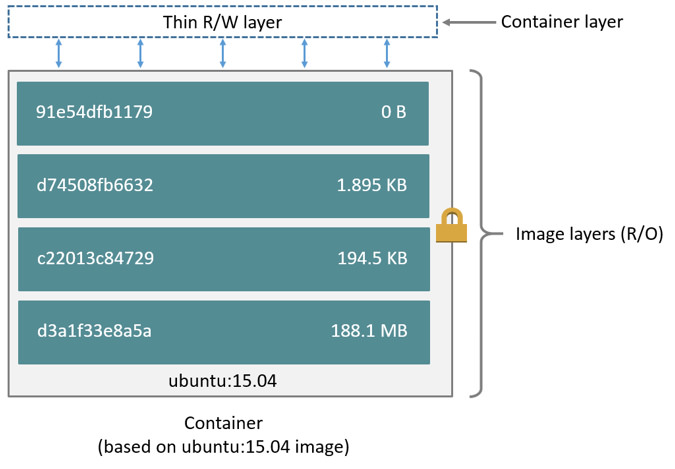
Multiple Containers can use the same Image. Each container has its own writable container layer, and all changes are stored in this container layer, multiple containers can share access to the same underlying image and yet have their own data state. The diagram below shows multiple containers sharing the same Debian image.
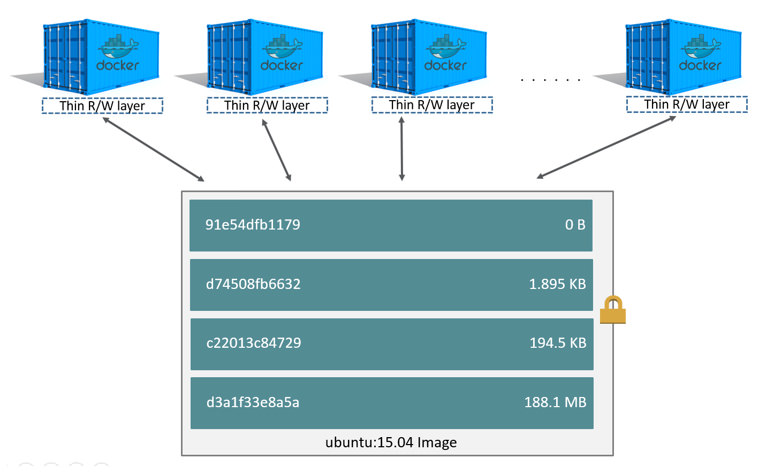
The following exercises will help to illustrate those concepts in practice.
Let’s start by looking at layers and how files written to a container are managed by something called copy on write.
Docker images are the basis of containers. In the previous example, you pulled the dockersamples/static-site image from the registry and asked the Docker client to run a container based on that image. To see the list of images that are available locally on your system, run the docker image ls command.
$ docker image ls
REPOSITORY                  TAG                 IMAGE ID            CREATED             SIZE
dockersamples/static-site   latest              92a386b6e686        2 hours ago        190.5 MB
nginx                       latest              af4b3d7d5401        3 hours ago        190.5 MB
python                      3.12                1c32174fd534        14 hours ago        676.8 MB
postgres                    17                  88d845ac7a88        14 hours ago        432.5 MB
traefik                     latest              27b4e0c6b2fd        4 days ago          160.7 MB
node                        22                  42426a5cba5f        6 days ago          633.7 MB
redis                       latest              4f5f397d4b7c        7 days ago          177.5 MB
mongo                       latest              467eb21035a8        7 days ago          309.7 MB
alpine                      latest              70c557e50ed6        8 days ago          7.8 MB
debian                      bookworm-slim       21f6ce84e43c        8 days ago          74.8 MB
Above is a list of images that we’ve pulled from the Docker registry and images I created myself (we’ll shortly see how). You will have a different list of images on your machine. The TAG refers to a particular snapshot of the image and the ID is the corresponding unique identifier or hash for that image.
For simplicity, you can think of an image functions similarly to a git repository - images can be committed with changes and have multiple versions. When you do not provide a specific version number, the client defaults to latest.
-
Pull a specific version of
debianimage as follows:$ docker image pull debian:bullseye-slimNote If you do not specify the version number of the image then, as mentioned, the Docker client will default to a version named
latest. -
So for example, the
docker image pullcommand given below will always pull thelatesttag of an image. The example below pullsdebian:latestby default.$ docker image pull debian
To get a new Docker image you can either get it from a registry (such as the Docker Hub) or create your own. There are hundreds of thousands of images available on Docker Hub. You can also search for images directly from the command line using docker search.
An important distinction with regard to images is between base images and child images.
-
Base images are images that have no parent images, usually images with an OS like ubuntu, alpine or debian.
-
Child images are images that build on base images and add additional functionality.
Another key concept is the idea of official images and user images. (Both of which can be base images or child images.)
-
Official images are Docker-sanctioned images. Docker, Inc. sponsors a dedicated team that is responsible for reviewing and publishing all Official Repositories content. This team works in collaboration with upstream software maintainers, security experts, and the broader Docker community. These are not prefixed by an organization or user name. In the list of images above, the
python,node,alpine,debianandnginximages are official (base) images. To find out more about them, check out the Official Images Documentation. -
User images are images created and shared by users like you. They build on base images and add additional functionality. Typically these are formatted as
user/image-name. Theuservalue in the image name is your Docker Hub user or organization name.
Task 2: Layers and Copy on Write
-
Pull the Debian Bookworm Slim image
$ docker image pull debian:bookworm-slim bookworm-slim: Pulling from library/debian 952b15bbc7fb: Pull complete Digest: sha256:ac58ff7fe25edc58bdf0067ca99df00014dbd032e2246d30a722fa348fd799a5 Status: Downloaded newer image for debian:bookworm-slim docker.io/library/debian:bookworm-slim -
Pull a PostgreSQL image
$ docker image pull postgres:17
17: Pulling from library/postgres
952b15bbc7fb: Already exists
c3beef926275: Pull complete
dd40ffbb6cb3: Pull complete
31691bc52e3b: Pull complete
0b4de91620aa: Pull complete
1ecbfd4a00bd: Pull complete
91656c5c74a8: Pull complete
fbc99aa6f426: Pull complete
Digest: sha256:b85481f8f2a65c10dec198e562a751676e926da83018e5590d00be86e5c9f635
Status: Downloaded newer image for postgres:17
docker.io/library/postgres:17
What do you notice about the output from the Docker pull request for PostgreSQL?
The first layer pulled says:
952b15bbc7fb: Already existsNotice that the layer id (
952b15bbc7fb) is the same for the first layer of the PostgreSQL image and the only layer in the Debian Bookworm Slim image. And because we already had pulled that layer when we pulled the Debian image, we didn’t have to pull it again.So, what does that tell us about the PostgreSQL image? Since each layer is created by a line in the image’s Dockerfile, we know that the PostgreSQL image is based on the Debian Bookworm Slim base image. We can confirm this by looking at the Dockerfile on GitHub.
The first line in the Dockerfile is:
FROM debian:bookworm-slimThis will import that layer into the PostgreSQL image.So layers are created by the Dockerfile and are shared between images. When you start a container, a writeable layer is added to the base image.
Next you will create a file in our container, and see how that’s represented on the host file system.
Note: Not all database images share the same base. For instance, MariaDB is based on
ubuntu:noble, not Debian. If you pulledmariadb:11afterdebian:bookworm-slim, you would not see shared layers, because they use different base images. Always check an image’s Dockerfile to understand its lineage. -
Start a Debian container, shell into it.
$ docker container run --tty --interactive --name mydebian debian:bookworm-slim bash root@e09203d84deb:/# -
Create a file and then list out the directory to make sure it’s there:
root@e09203d84deb:/# touch test-file
root@e09203d84deb:/# ls
bin  boot  dev	etc  home  lib	lib64  media  mnt  opt	proc  root  run  sbin  srv  sys  test-file  tmp  usr  var
We can see
test-fileexists in the root of the container’s file system.What has happened is that when a new file was written to the disk, the Docker storage driver placed that file in its own layer. This is called copy on write - as soon as a change is detected the change is copied into the writeable layer. That layer is represented by a directory on the host file system. All of this is managed by the Docker storage driver.
-
Exit the container but leave it running by pressing
ctrl-pand thenctrl-q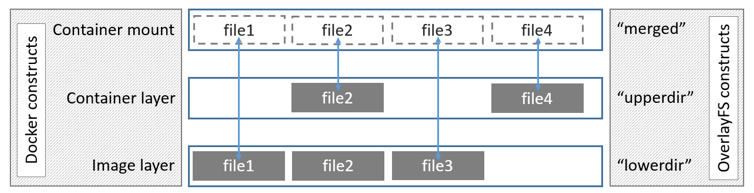
Our Docker host utilizes OverlayFS with the overlay2 storage driver.
OverlayFS layers two directories on a single Linux host and presents them as a single directory. These directories are called layers and the unification process is referred to as a union mount. OverlayFS refers to the lower directory as lowerdir and the upper directory a upperdir. “Upper” and “Lower” refer to when the layer was added to the image. In our example the writeable layer is the most “upper” layer. The unified view is exposed through its own directory called merged.
-
Stop the container
$ docker container stop mydebian -
Ensure that your container still exists
$ docker container ls --all CONTAINER ID IMAGE COMMAND CREATED STATUS PORTS NAMES 674d7abf10c6 debian:bookworm-slim "bash" 36 minutes ago Exited (0) 2 minutes ago mydebian -
Start the Debian container again
$ docker container start mydebian -
Attach to the container, hit
entertwice after completing the command$ docker container attach mydebianBecause the container still exists, the files are still available on your file system. At this point the file we created previously still exists.
However, if we remove the container, the directories on the host file system will be removed, and your changes will be gone.
-
Remove the container and list the directory contents
$ docker container rm mydebian
mydebian
The files that were created are now gone and the container now reverts back to the base image which it was created from if we start it again.
Task 3: Understanding Docker Volumes
Docker volumes are directories on the host file system that are not managed by the storage driver. Since they are not managed by the storage drive they offer a couple of important benefits.
-
Performance: Because the storage driver has to create the logical filesystem in the container from potentially many directories on the local host, accessing data can be slow. Especially if there is a lot of write activity to that container. In fact you should try and minimize the amount of writes that happen to the container’s filesystem, and instead direct those writes to a volume
-
Persistence: Volumes are not removed when the container is deleted. They exist until explicitly removed. This means data written to a volume can be reused by other containers.
Volumes can be anonymous or named. Anonymous volumes have no way to be explicitly referenced. They are almost exclusively used for performance reasons as you cannot persist data effectively with anonymous volumes. Named volumes can be explicitly referenced so they can be used to persist data and increase performance.
The next sections will cover both anonymous and named volumes.
Special Note: These next sections were adapted from Arun Gupta’s excellent tutorial on persisting data with Docker databases.
Anonymous Volumes
Take a look at the MariaDB Dockerfile you will find the following line:
VOLUME /var/lib/mysql
This line sets up an anonymous volume in order to increase database performance by avoiding sending a bunch of writes through the Docker storage driver.
Note: An anonymous volume is a volume that hasn’t been explicitly named. This means that it’s extremely difficult to use the volume later with a new container. Named volumes solve that problem, and will be covered later in this section.
-
Start a MariaDB container
$ docker container run --name mariadb -e MARIADB_USER=dbuser -e MARIADB_PASSWORD=dbpass -e MARIADB_DATABASE=sample -e MARIADB_ROOT_PASSWORD=supersecret -d mariadb:11
acf185dc16e274b2f332266a1bfc6d1df7d7b4f780e6a7ec6716b40cafa5b3c3
When we start the container the anonymous volume is created:
-
Use
docker container inspectto view the details of the anonymous volume$ docker container inspect -f "in the {{.Name}} container {{(index .Mounts 0).Destination}} is mapped to {{(index .Mounts 0).Source}}" mariadbThis command will return:
in the /mariadb container /var/lib/mysql is mapped to /var/lib/docker/volumes/cd79b3301df29d13a068d624467d6080354b81e34d794b615e6e93dd61f89628/_dataAs mentioned anonymous volumes will not persist data between containers, they are almost always used to increase performance.
-
Shell into your running MariaDB container and log into MariaDB
$ docker container exec --tty --interactive mariadb bash root@132f4b3ec0dc:/# mariadb --user=dbuser --password=dbpass Welcome to the MariaDB monitor. Commands end with ; or \g. Your MariaDB connection id is 3 Server version: 11.4.2-MariaDB-ubu2404 mariadb.org binary distribution Copyright (c) 2000, 2018, Oracle, MariaDB Corporation Ab and others. Type 'help;' or '\h' for help. Type '\c' to clear the current input statement. -
Create a new table
MariaDB [(none)]> show databases; +--------------------+ | Database | +--------------------+ | information_schema | | sample | +--------------------+ 2 rows in set (0.00 sec) MariaDB [(none)]> use sample; Database changed MariaDB [sample]> show tables; Empty set (0.00 sec) MariaDB [sample]> create table user(name varchar(50)); Query OK, 0 rows affected (0.01 sec) MariaDB [sample]> show tables; +------------------+ | Tables_in_sample | +------------------+ | user | +------------------+ 1 row in set (0.00 sec) -
Exit MariaDB and the MariaDB container.
MariaDB [sample]> exit Bye root@132f4b3ec0dc:/# exit exit -
Stop the container and restart it
$ docker container stop mariadb mariadb $ docker container start mariadb mariadb -
Shell back into the running container and log into MariaDB
$ docker container exec --interactive --tty mariadb bash root@132f4b3ec0dc:/# mariadb --user=dbuser --password=dbpass Welcome to the MariaDB monitor. Commands end with ; or \g. Your MariaDB connection id is 3 Server version: 11.4.2-MariaDB-ubu2404 mariadb.org binary distribution Copyright (c) 2000, 2018, Oracle, MariaDB Corporation Ab and others. Type 'help;' or '\h' for help. Type '\c' to clear the current input statement. -
Ensure the table created previously still exists
MariaDB [(none)]> use sample; Reading table information for completion of table and column names You can turn off this feature to get a quicker startup with -A Database changed MariaDB [sample]> show tables; +------------------+ | Tables_in_sample | +------------------+ | user | +------------------+ 1 row in set (0.00 sec) -
Exit MariaDB and the MariaDB container.
MariaDB [sample]> exit
Bye

root@132f4b3ec0dc:/# exit
exit
The table persisted across container restarts, which is to be expected. In fact, it would have done this whether or not we had actually used a volume as shown in the previous section.
-
Let’s look at the volume again
$ docker container inspect -f "in the {{.Name}} container {{(index .Mounts 0).Destination}} is mapped to {{(index .Mounts 0).Source}}" mariadb
in the /mariadb container /var/lib/mysql is mapped to /var/lib/docker/volumes/cd79b3301df29d13a068d624467d6080354b81e34d794b615e6e93dd61f89628/_data
We do see the volume was not affected by the container restart either.
Where people often get confused is in expecting that the anonymous volume can be used to persist data BETWEEN containers.
To examine that delete the old container, create a new one with the same command, and check to see if the table exists.
-
Remove the current MariaDB container
$ docker container rm --force mariadb mariadb -
Start a new container with the same command that was used before
$ docker container run --name mariadb -e MARIADB_USER=dbuser -e MARIADB_PASSWORD=dbpass -e MARIADB_DATABASE=sample -e MARIADB_ROOT_PASSWORD=supersecret -d mariadb:11 eb15eb4ecd26d7814a8da3bb27cee1a23304fab1961358dd904db37c061d3798 -
List out the volume details for the new container
$ docker container inspect -f "in the {{.Name}} container {{(index .Mounts 0).Destination}} is mapped to {{(index .Mounts 0).Source}}" mariadb
in the /mariadb container /var/lib/mysql is mapped to /var/lib/docker/volumes/e0ffdc6b4e0cfc6e795b83cece06b5b807e6af1b52c9d0b787e38a48e159404a/_data
Notice this directory is different than before.
-
Shell back into the running container and log into MariaDB
$ docker container exec --interactive --tty mariadb bash root@132f4b3ec0dc:/# mariadb --user=dbuser --password=dbpass Welcome to the MariaDB monitor. Commands end with ; or \g. Your MariaDB connection id is 3 Server version: 11.4.2-MariaDB-ubu2404 mariadb.org binary distribution Copyright (c) 2000, 2018, Oracle, MariaDB Corporation Ab and others. Type 'help;' or '\h' for help. Type '\c' to clear the current input statement. -
Check to see if table created previously still exists
MariaDB [(none)]> use sample; Database changed MariaDB [sample]> show tables; Empty set (0.00 sec) -
Exit MariaDB and the MariaDB container.
MariaDB [sample]> exit Bye root@132f4b3ec0dc:/# exit exit -
Remove the container
$ docker container rm --force mariadb
mariadb
So while a volume was used to store the new table in the original container, because it wasn’t a named volume the data could not be persisted between containers.
To achieve persistence a named volume should be used.
Named Volumes
A named volume (as the name implies) is a volume that’s been explicitly named and can easily be referenced.
A named volume can be created on the command line, in a docker-compose file, and when you start a new container. They CANNOT be created as part of the image’s dockerfile.
-
Start a MariaDB container with a named volume (
mydbdata)$ docker container run --name mariadb \ -e MARIADB_USER=dbuser \ -e MARIADB_PASSWORD=dbpass \ -e MARIADB_DATABASE=sample \ -e MARIADB_ROOT_PASSWORD=supersecret \ --detach \ --mount type=volume,source=mydbdata,target=/var/lib/mysql \ mariadb:11Because the newly created volume is empty, Docker will copy over whatever existed in the container at
/var/lib/mysqlwhen the container starts.Docker volumes are primitives just like images and containers. As such, they can be listed and removed in the same way.
-
List the volumes on the Docker host
$ docker volume ls DRIVER VOLUME NAME local 55c322b9c4a644a5284ccb5e4d7b6b466a0534e26d57c9ef4221637d39cf9a88 local cc44059d23e0a914d4390ea860fd35b2acdaa480e83c025fb381da187b652a66 local e0ffdc6b4e0cfc6e795b83cece06b5b807e6af1b52c9d0b787e38a48e159404a local mydbdata -
Inspect the volume
$ docker volume inspect mydbdata
[
    {
        "CreatedAt": "2017-10-13T19:55:10Z",
        "Driver": "local",
        "Labels": null,
        "Mountpoint": "/var/lib/docker/volumes/mydbdata/_data",
        "Name": "mydbdata",
        "Options": {},
        "Scope": "local"
    }
]
Any data written to
/var/lib/mysqlin the container will be rerouted to/var/lib/docker/volumes/mydbdata/_datainstead. -
Shell into your running MariaDB container and log into MariaDB
$ docker container exec --tty --interactive mariadb bash root@132f4b3ec0dc:/# mariadb --user=dbuser --password=dbpass Welcome to the MariaDB monitor. Commands end with ; or \g. Your MariaDB connection id is 3 Server version: 11.4.2-MariaDB-ubu2404 mariadb.org binary distribution Copyright (c) 2000, 2018, Oracle, MariaDB Corporation Ab and others. Type 'help;' or '\h' for help. Type '\c' to clear the current input statement. -
Create a new table
MariaDB [(none)]> use sample; Database changed MariaDB [sample]> show tables; Empty set (0.00 sec) MariaDB [sample]> create table user(name varchar(50)); Query OK, 0 rows affected (0.01 sec) MariaDB [sample]> show tables; +------------------+ | Tables_in_sample | +------------------+ | user | +------------------+ 1 row in set (0.00 sec) -
Exit MariaDB and the MariaDB container.
MariaDB [sample]> exit Bye root@132f4b3ec0dc:/# exit exit -
Remove the MariaDB container
$ docker container rm --force mariadbBecause MariaDB was writing out to a named volume, we can start a new container with the same data.
When the container starts it will not overwrite existing data in a volume. So the data created in the previous steps will be left intact and mounted into the new container.
-
Start a new MariaDB container
$ docker container run --name new_mariadb \ -e MARIADB_USER=dbuser \ -e MARIADB_PASSWORD=dbpass \ -e MARIADB_DATABASE=sample \ -e MARIADB_ROOT_PASSWORD=supersecret \ --detach \ --mount type=volume,source=mydbdata,target=/var/lib/mysql \ mariadb:11 -
Shell into your running MariaDB container and log into MariaDB
$ docker container exec --tty --interactive new_mariadb bash root@132f4b3ec0dc:/# mariadb --user=dbuser --password=dbpass Welcome to the MariaDB monitor. Commands end with ; or \g. Your MariaDB connection id is 3 Server version: 11.4.2-MariaDB-ubu2404 mariadb.org binary distribution Copyright (c) 2000, 2018, Oracle, MariaDB Corporation Ab and others. Type 'help;' or '\h' for help. Type '\c' to clear the current input statement. -
Check to see if the previously created table exists in your new container.
MariaDB [(none)]> use sample;
Reading table information for completion of table and column names
You can turn off this feature to get a quicker startup with -A

Database changed

MariaDB [sample]> show tables;
+------------------+
| Tables_in_sample |
+------------------+
| user             |
+------------------+
1 row in set (0.00 sec)
The data will exist until the volume is explicitly deleted.
-
Exit MariaDB and the MariaDB container.
MariaDB [sample]> exit Bye root@132f4b3ec0dc:/# exit exit -
Remove the new MariaDB container and volume
$ docker container rm --force new_mariadb
new_mariadb

$ docker volume rm mydbdata
mydbdata
If a new container was started with the previous command, it would create a new empty volume.
Next Steps
For the next step in the tutorial, head over to Multi-Stage Builds